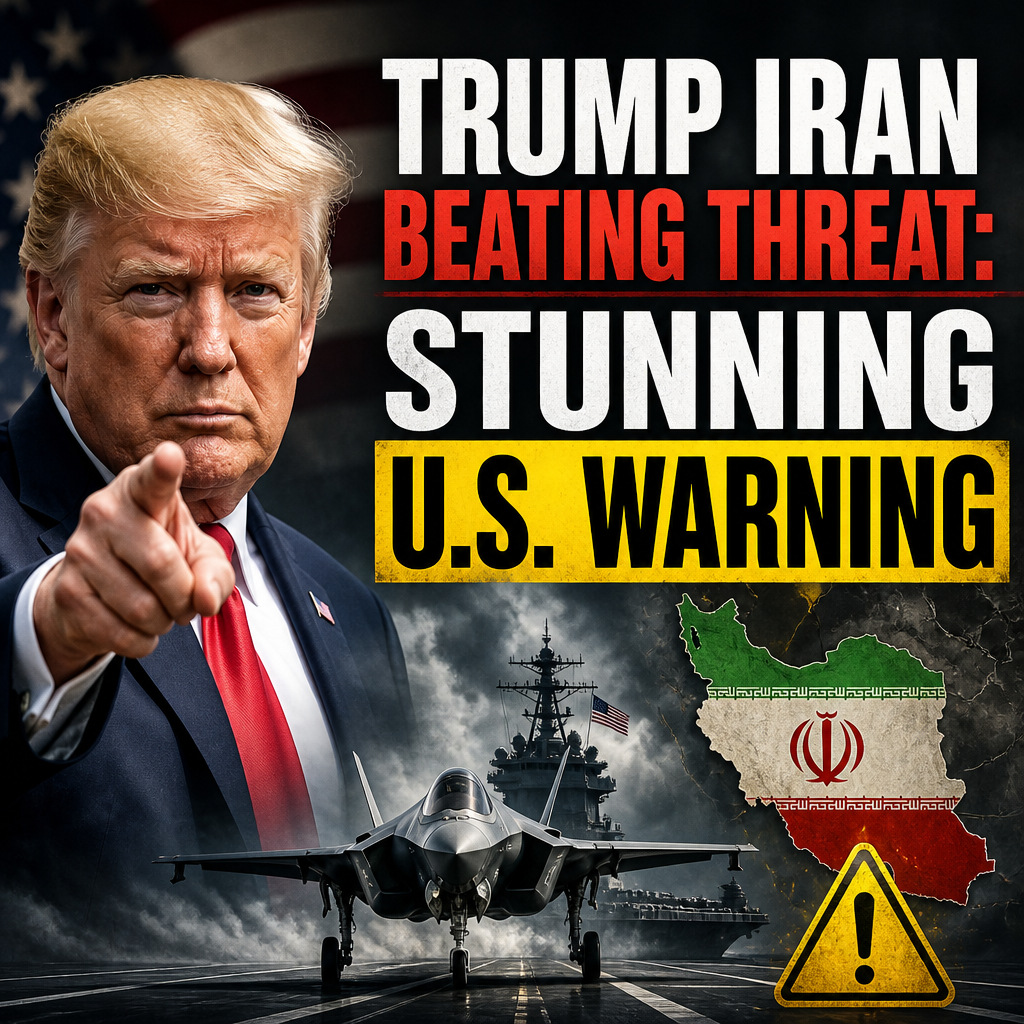
Trump Iran Beating Threat: Stunning U.S. Warning


Trump Iran beating threat has quickly become another flashpoint in an already volatile relationship between Washington and Tehran, with President Donald Trump warning that the United States would respond harshly after American bases were again targeted. The language was unusually blunt, and it landed at a moment when the risk of miscalculation in the Middle East is already high.
What makes this episode more complicated is that the news cycle around it is not coming from a single direction. Reporting across international outlets points to a familiar pattern: the U.S. president projecting strength, Iran insisting it will not be intimidated, and outside observers warning that each new exchange raises the chance of a broader conflict. That mix of toughness, defiance, and uncertainty is now shaping how the confrontation is being interpreted.



What Trump’s warning signals
Trump’s remarks were not just another routine warning. By saying the U.S. would deliver a “beating” if attacks continued, he framed the confrontation in personal, forceful terms that fit his long-standing preference for deterrence through pressure. Supporters of that approach argue that a leader who speaks this way can discourage adversaries from testing American resolve.
But there is a downside to that style. In a crisis involving Iran, rhetoric can matter as much as military capability. A statement meant to deter can also box both sides in, making it harder to step back without appearing weak. That is one reason the reaction from analysts has been cautious: strong words may satisfy a domestic political audience, but they can also narrow the space for diplomacy.




Reports also suggest the warning comes amid repeated strikes or threats near U.S. positions in the region, which helps explain why the administration is responding so aggressively. From Washington’s point of view, the issue is not only about one attack but about signaling that attacks on American forces will not be tolerated.
A familiar cycle of escalation
The U.S.-Iran relationship has spent years locked in a cycle of provocation and retaliation. One side applies pressure, the other responds, and both claim they are acting defensively. That cycle is dangerous because each move can be justified in the moment, even while the overall situation worsens.
In practical terms, that means a speech like Trump’s can be read in two very different ways:
– as a warning designed to stop further attacks
– or as a sign that Washington is preparing to escalate if restraint fails
Both readings can be true at once.
How Iran and other voices may be reading it
From Tehran’s perspective, the warning is unlikely to be taken at face value as a simple defensive message. Iranian officials have often portrayed U.S. threats as proof that Washington is the aggressor, and that framing helps them justify a hard line at home and across the region. In other words, a threat from Trump may strengthen Iranian arguments rather than weaken them, especially if it is seen as politically motivated.
That does not mean Iran will respond recklessly. More often, Iranian strategy has involved calibrated retaliation, deniability, and signaling through allied groups or regional proxies. That approach allows Iran to apply pressure while trying to avoid a direct war it cannot easily control. If recent reports are correct, the concern is not just about a single exchange but about whether either side misreads the other’s threshold.
Sky News-style coverage of these moments tends to emphasize the wider diplomatic and security risk: even when leaders claim they want peace, repeated military messaging can create a volatile atmosphere in which one incident spirals into something much larger. That is the central concern here. The issue is less whether either side wants full-scale war than whether enough restraint remains in the system to prevent one.
Why the international reaction matters
RT’s angle in similar geopolitical disputes often highlights how U.S. threats are viewed outside Washington as evidence of American overreach. Whether or not that framing is shared by all audiences, it reflects a real divide in interpretation: some see the U.S. as enforcing deterrence, while others see it as escalating tensions it helped create.
That split matters because the Middle East is not a closed bilateral contest. Regional allies, shipping routes, energy markets, and proxy actors all make the stakes much larger than a simple tit-for-tat. Even a limited clash can have consequences for:
– global oil prices
– security for U.S. personnel in the region
– already fragile diplomatic channels
– civilian populations near conflict zones
This is why the reaction from international media is less about the shock value of Trump’s words and more about what they could lead to if followed by action. A hard warning can be useful if it prevents violence. It becomes dangerous if it encourages each side to assume the other is bluffing.
A blunt warning, but no clear resolution
The honest conclusion is that there is no clean resolution in sight. Trump’s language suggests he wants Iran to believe the costs of continued attacks will be severe. Iran, meanwhile, is unlikely to soften simply because Washington speaks more forcefully. That means the crisis now rests on a narrow question: will both sides interpret the warning as a deterrent, or as the opening move in another escalation?
What stands out in the reporting is not just the threat itself, but the uncertainty around its effect. Strong rhetoric can sometimes create calm if it convinces an opponent to back down. It can also make a confrontation more likely by pushing both sides toward the edge. At this stage, the second outcome cannot be dismissed.
For now, the safest reading is that the U.S. is trying to reassert deterrence, Iran is likely testing how far that deterrence goes, and the world is left hoping that the message is heard without being answered in kind. In a region where words can quickly become weapons, that is not a comforting place to be.